
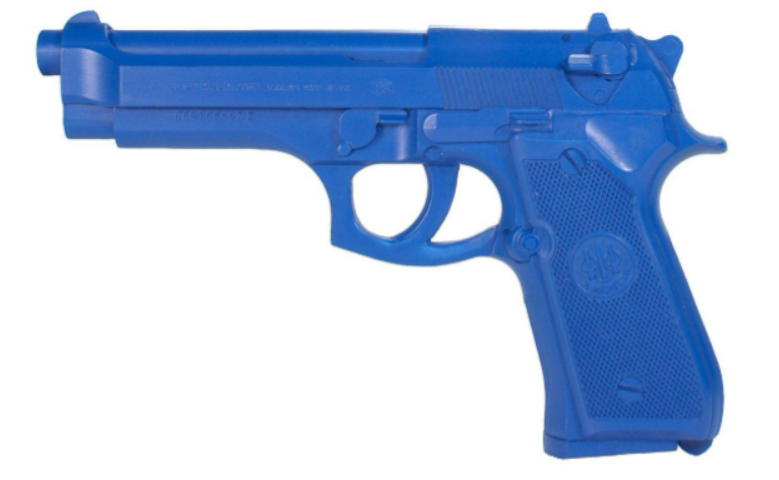
BERETTA 92F
$64.74
- SKUFSB92F
- UPC
- BrandBlueguns
Discontinued
Description
Included:
The Beretta 92F is the definitive military evolution of the 92 series. Introduced in 1984 (originally as the 92SB-F), it was the specific model that won the U.S. military's XM9 trials to replace the M1911A1, eventually becoming the M9.
While it looks almost identical to the modern 92FS, the 92F represents the transition from a specialized police tool to a mass-produced global military standard.
Key Military Upgrades (F vs. SB)
To meet the rigorous demands of the U.S. Army, Beretta made several specific engineering changes to the previous 92SB model:
Bruniton Coating: Replaced the traditional high-polish bluing with a matte, non-reflective Teflon-based finish (Bruniton) for superior corrosion resistance and durability in combat environments.
Chrome-Lined Bore: The barrel and chamber were hard-chromed to extend barrel life and resist the wear of high-volume military shooting.
Squared "Combat" Trigger Guard: The rounded trigger guard was replaced with a squared-off version, intended to provide a stable rest for the support-hand index finger (a popular shooting technique at the time).
Recurved Grip: The front and back straps of the grip were slightly reshaped (re-curved) to improve the ergonomics and pointability for a wider range of hand sizes.
100% Part Interchangeability: Every internal component was redesigned to be fully interchangeable with any other 92F, simplifying maintenance for large-scale armories.
The Critical Difference: 92F vs. 92FS
This is the most important distinction for collectors and shooters.
The "Slide Issue": During early U.S. military testing, a very small number of 92F slides fractured and separated from the frame, occasionally striking the shooter in the face. This was later attributed to a combination of metallurgical issues and the use of extremely high-pressure "submachine gun" ammunition.
The "FS" Fix: Beretta responded by creating the 92FS. The "S" stands for "Super" (or "Safety"). It added an enlarged hammer pin head that fits into a groove underneath the slide. If a slide were to break on a 92FS, this pin catches the rear portion, preventing it from flying back at the shooter.
Identification: You can tell a 92F from a 92FS by looking at the left side of the frame just above the grip panel. A 92FS will have a visible, oversized circular pin head; the 92F will have a standard-sized pin.
Legacy (2026 Status)
In 2026, the 92F is considered a "modern classic." While it lacks the slide-retention safety of the 92FS, it is perfectly safe for standard-pressure 9mm ammunition and is highly prized by collectors for being the "original" military contract configuration.
The Beretta 92F is the definitive military evolution of the 92 series. Introduced in 1984 (originally as the 92SB-F), it was the specific model that won the U.S. military's XM9 trials to replace the M1911A1, eventually becoming the M9.
While it looks almost identical to the modern 92FS, the 92F represents the transition from a specialized police tool to a mass-produced global military standard.
Key Military Upgrades (F vs. SB)
To meet the rigorous demands of the U.S. Army, Beretta made several specific engineering changes to the previous 92SB model:
Bruniton Coating: Replaced the traditional high-polish bluing with a matte, non-reflective Teflon-based finish (Bruniton) for superior corrosion resistance and durability in combat environments.
Chrome-Lined Bore: The barrel and chamber were hard-chromed to extend barrel life and resist the wear of high-volume military shooting.
Squared "Combat" Trigger Guard: The rounded trigger guard was replaced with a squared-off version, intended to provide a stable rest for the support-hand index finger (a popular shooting technique at the time).
Recurved Grip: The front and back straps of the grip were slightly reshaped (re-curved) to improve the ergonomics and pointability for a wider range of hand sizes.
100% Part Interchangeability: Every internal component was redesigned to be fully interchangeable with any other 92F, simplifying maintenance for large-scale armories.
The Critical Difference: 92F vs. 92FS
This is the most important distinction for collectors and shooters.
The "Slide Issue": During early U.S. military testing, a very small number of 92F slides fractured and separated from the frame, occasionally striking the shooter in the face. This was later attributed to a combination of metallurgical issues and the use of extremely high-pressure "submachine gun" ammunition.
The "FS" Fix: Beretta responded by creating the 92FS. The "S" stands for "Super" (or "Safety"). It added an enlarged hammer pin head that fits into a groove underneath the slide. If a slide were to break on a 92FS, this pin catches the rear portion, preventing it from flying back at the shooter.
Identification: You can tell a 92F from a 92FS by looking at the left side of the frame just above the grip panel. A 92FS will have a visible, oversized circular pin head; the 92F will have a standard-sized pin.
Legacy (2026 Status)
In 2026, the 92F is considered a "modern classic." While it lacks the slide-retention safety of the 92FS, it is perfectly safe for standard-pressure 9mm ammunition and is highly prized by collectors for being the "original" military contract configuration.